An English- and French-language playlist are spontenuously crossed checked with the Great Depression to the 2020s to see the tendency if any.
Every so often, I hear an old song and wonder what the world felt like when people first sang it at the time. Why do some classical piece still stay timely with us as Beethoveen, Chopin, Mozar? How do songs get to the whole world just by its melody regardless of original lyrics for some phenomynom such as Jpop, Kpop? Interestingly, any person even little kids on earth could recognise the “universal” melody of “Happy Birthday” “Happy new year” translated in multiple languages….

Escalated to a more societal economy standpoints, I started to wonder “How did we get “Dancing Queen” after an oil shock” 1970s; “I Gotta Feeling” during a financial crisis 2008, and “Dynamite” in the year we stayed home – covid 19 – 2020?
Perhaps there is a human reason: no one gets far with less joy for long. We all look for ways to lighten up a bit especially when ambidexterity is highly in demand.
I had a theory that hard times produce brighter hits and booming times make room for sadder ones. It is a catchy theory. History, predictably, has a more interesting playlist.
Oprah Winfrey’s (2026) video-podcast conversation with Andrew Ross Sorkin about his book 1929 (2025) brought me back to the Wall Street crash and the Great Depression that followed. They talk about financial warning signs; I kept thinking about another human reflex: what did people sing when confidence broke? The 1930s gave us both “Happy Days Are Here Again” and “Brother, Can You Spare a Dime?” Hope and hardship shared a record shelf. (Listen to the episode.)

From the Great Depression to pandemic pop
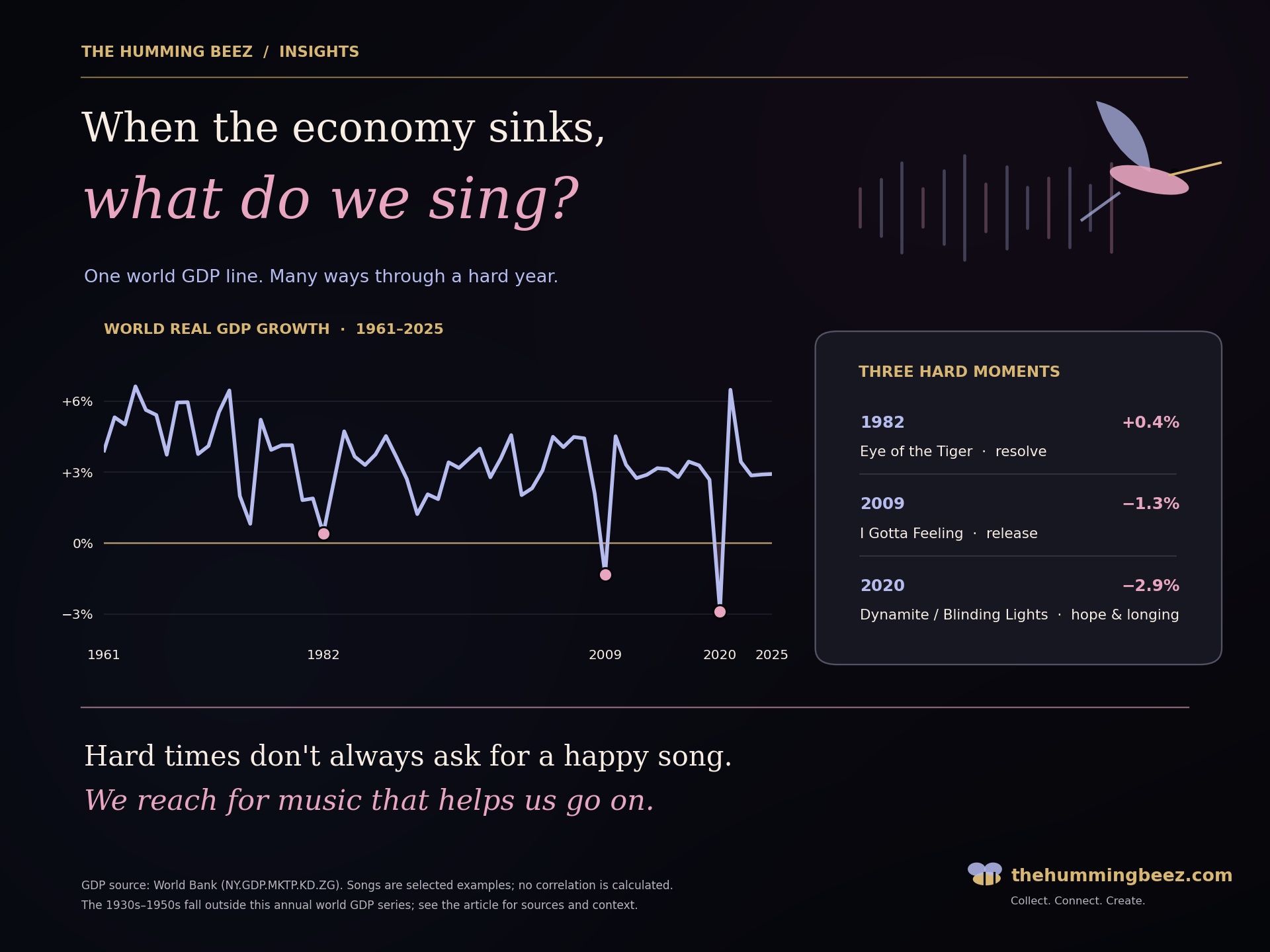
The economic measure below is world real GDP growth, using one World Bank (n.d.) series throughout. Its annual world figures begin in 1961. The dashes mean “outside this series,” not “no economic crisis”: Bolt and van Zanden (2025) discuss historical GDP reconstructions, and Kose and Sugawara (2020) identify a global recession in 1930–32. I have left those estimates separate rather than stitch two methods together.
| Decade and major event | English- or French-language hits and global crossovers | World GDP growth, annual average |
|---|---|---|
| 1930s · After the 1929 crash: Great Depression | U.S. “Happy Days Are Here Again” (1930) and “Brother, Can You Spare a Dime?” (1932): hope and hardship. | NA |
| 1940s · World War II, then rebuilding | UK “We’ll Meet Again” (1939 recording; wartime favourite); FR “La Vie en rose” (1946): reunion and a new shade of life. | NA |
| 1950s · Postwar expansion | UK “Que Sera, Sera” (1956); FR “Bambino” (Dalida, 1956): reassurance and play. | NA |
| 1960s · Cold War and social change | UK “All You Need Is Love” (1967); FR “Tous les garçons et les filles” (Françoise Hardy, 1962): idealism with a little loneliness. | +5.3% |
| 1970s · Oil shocks, inflation | UK “Dancing Queen” (ABBA, 1976); FR “L’été indien” (Joe Dassin, 1975): dance floor and daydream. | +4.0% |
| 1980s · 1982 recession and debt crisis | UK “Eye of the Tiger” (1982), then “Wake Me Up Before You Go-Go” (Wham!, 1984): fight, then dance. | +3.0% |
| 1990s · Globalisation, Asian financial crisis | UK “Wannabe” (Spice Girls, 1996), “I Want It That Way” (Backstreet Boys, 1999) and “My Heart Will Go On” (Céline Dion, 1998); FR “Belle” (1998): friendship, yearning, heartbreak. | +2.8% |
| 2000s · Global financial crisis | UK “Umbrella” (Rihanna, 2007), “Viva la Vida” (Coldplay, 2008), “I Gotta Feeling” (Black Eyed Peas, 2009): shelter, fallen crowns, a night out. | +3.0% |
| 2010s · Uneven recovery and streaming | UK “Someone Like You” (Adele, 2011); FR “Papaoutai” (Stromae, 2013); UK/U.S. “Happy” (Pharrell, 2013–14): grief, absence, joy. | +3.2% |
| 2020–25 · Pandemic and rebound | Global “Blinding Lights” and “Dynamite” (The Weeknd and BTS, 2020); “Flowers” (Miley Cyrus, 2023): longing, brightness, self-reliance. | +2.6% |
The chart and every number in the table use the same World Bank indicator: annual real GDP growth for the world. It measures output, not happiness or music’s emotional tone.
The second chart pairs selected chart years with world GDP growth in those years. “Happy” and “Papaoutai” share 2013; “Dynamite” and “Blinding Lights” share 2020. The mood groupings are my reading, not measured song scores. This is a visual comparison, not a statistical correlation.

Where the theory sings and where it doesn’t
Decade averages can hide a terrible year. World growth reached 0.4% in 1982, fell 1.3% in 2009 and fell 2.9% in 2020. “Eye of the Tiger,” “I Gotta Feeling” and BTS’s “Dynamite” arrived in those respective years. BTS (2020) called “Dynamite” a message of hope. That is a remarkable match between an artist’s intention and a hard moment, though three songs cannot tell us what the whole world wanted.

The other half of my theory slips. Céline Dion’s “My Heart Will Go On” was a Titanic film hit in 1998: a movie can explain a chart-topper better than the business cycle. Meanwhile, Pharrell’s “Happy” flourished during the 2010s’ uneven recovery. The economy does not correlatedly DJ every party 😉

Do tough times make happy songs more popular?
Researchers suggest a more interesting answer than simply “happy songs win.” Pettijohn and Sacco (2009) found that, in threatening U.S. social and economic conditions, popular songs tended to be slower, more comforting and more meaningful. De Lucio and Palomeque (2023), studying U.S. charts from 1958 to 2019, found more positive lyrics gaining favour when unemployment was high. Palomeque and de Lucio (2024) found more listening to positive lyrics across 31 OECD countries during economic and pandemic shocks. These findings measure different things; a comforting song need not have a dance beat.

I hear that difference in the songs themselves. Adele can make heartbreak feel understood; Édith Piaf makes hope sound hard-won. Audrey Hepburn’s “Moon River” offers quiet company, while the Spice Girls give us friends to sing with. Music can inspire, comfort and connect because it gives a private feeling a form other people can share. When times are hard, we may look for that feeling in old favourites as well as new releases: Yeung (2023) found that UK listeners returned to older, positive songs during the first lockdown.
The songs that outlast the charts
Vivaldi, Chopin, Mozart and Beethoven have outlasted centuries of changing tastes and technologies. Some songs carry one summer; others keep meeting new listeners in rooms their creators could never have imagined. Viral numbers cannot measure that kind of staying power.

AI can help an artist generate, arrange and explore. It has not existed long enough to be judged by a centuries-long test. What I value in a masterpiece is the human work behind it: the choices, the revision and the life that gives it meaning. A quick chorus is one thing; making something another person can live with for years is another.
Perhaps my theory needs a better chorus: when times are hard, we do not always demand happy music. We reach for music that helps us go on.

#Scope, methodology and personal dislaimers:
This is a curated Anglophone and Francophone view, with documented global crossovers such as BTS. “World” describes the GDP series, not the reach of this playlist; other languages and music markets would tell other stories. UK, U.S. and FR denote chart or cultural markets, not artists’ nationalities.
Method. The World Bank’s world GDP growth series measures annual inflation-adjusted output growth; table values are simple averages within each decade, rounded to one decimal. The asterisk marks the 1961–69 average; † marks 2020–25, a partial decade. Songs are illustrative, not a ranked or representative sample; “Global” refers to a documented IFPI chart placement.
The second chart uses selected chart years (including the Weeknd’s 2020 global hit, released in 2019), not necessarily release dates. Chart methods and listening habits changed over time. A rigorous correlation would need a defined measure of musical mood and a representative, geographically matched time series. These selected songs cannot supply a defensible correlation coefficient or show that GDP caused a hit.

References:
Bolt, J., & van Zanden, J. L. (2025). Maddison-style estimates of the evolution of the world economy: A new 2023 update. Journal of Economic Surveys, 39, 631–671. https://doi.org/10.1111/joes.12618
BTS. (2020, September 24). In a new letter, BTS tells fans: “Hope is everywhere keep going.” Vogue. https://www.vogue.com/article/bts-letter-of-hope
de Lucio, J., & Palomeque, M. (2023). Music preferences as an instrument of emotional self-regulation along the business cycle. Journal of Cultural Economics, 47, 181–204. https://doi.org/10.1007/s10824-022-09454-7
Kose, M. A., & Sugawara, N. (2020, June 15). Understanding the depth of the 2020 global recession in 5 charts. World Bank Blogs. https://blogs.worldbank.org/en/opendata/understanding-depth-2020-global-recession-5-charts
Palomeque, M., & de Lucio, J. (2024). The soundtrack of a crisis: More positive music preferences during economic and social adversity. Journal of Happiness Studies, 25, Article 44. https://doi.org/10.1007/s10902-024-00757-4
Pettijohn, T. F., II, & Sacco, D. F., Jr. (2009). Tough times, meaningful music, mature performers: Popular Billboard songs and performer preferences across social and economic conditions in the USA. Psychology of Music, 37(2), 155–179. https://doi.org/10.1177/0305735608094512
Sorkin, A. R. (2025). 1929: Inside the greatest crash in Wall Street history and how it shattered a nation. Viking. https://www.penguinrandomhouse.com/books/665634/1929-by-andrew-ross-sorkin/
Winfrey, O. (Host). (2026, August 25). The financial mistake we keep making and how to stop [Video podcast episode]. In The Oprah Podcast. https://podcasts.apple.com/us/podcast/the-financial-mistake-we-keep-making-and-how-to-stop/id1782960381?i=1000785710156
World Bank. (n.d.). GDP growth (annual %) – World [Data set]. World Development Indicators. Retrieved September 27, 2026, from https://data.worldbank.org/indicator/NY.GDP.MKTP.KD.ZG?locations=1W
Yeung, T. Y.-C. (2023). Revival of positive nostalgic music during the first COVID-19 lockdown in the UK: Evidence from Spotify streaming data. Humanities and Social Sciences Communications, 10, Article 132. https://doi.org/10.1057/s41599-023-01614-0
Leave a Reply